Choosing the right compass for hiking enhances safety, navigation accuracy, and trail efficiency across varied terrain. The five picks below cover traditional lensatic models, baseplate navigators for map reading, and compact carabiner designs for quick access. Each option is evaluated for accuracy, durability, ease of use, and suitability from damp forests to alpine ridges. Compare at a glance with the table summarizing the five selected compasses and their standout strengths to help you decide which one belongs in your pack.
| Product | Brand | Type | Notable Strength |
|---|---|---|---|
| COTOUXKER Lensatic Hiking Compass | COTOUXKER | Lensatic | High accuracy readings |
| TurnOnSport Orienteering Compass | TurnOnSport | Baseplate/Orienteering | 360-degree bezel for map reading |
| SUUNTO A-30 NH USGS Compass | SUUNTO | Baseplate | Fixed declination, luminous marks |
| Sportneer Compass | Sportneer | Combat/Orienteering | Rear sight lens for precise readings |
| Coghlan’s Carabiner Compass | Coghlan’s | Carabiner | Luminous markers for night use |
COTOUXKER Lensatic Hiking Compass

High accuracy and reliability define this military-style lensatic compass. It delivers precise readings essential for camps, rugged hikes, and mountaineering routes where bearing accuracy matters. The device is built to withstand rough environments and offers water resistance for use in damp conditions, making it a dependable choice for year-round excursions.
Enhanced features support accuracy on challenging terrain. The lensatic function, prism lens, bubble level, and clear scales all contribute to reduced errors when taking bearings or reading maps. This design prioritizes reliability in dynamic environments, helping hikers stay oriented in low-visibility scenarios or unfamiliar landscapes.
Durability is a key selling point. Rugged construction suits backpacks, belts, or pocket carry, ensuring long-term performance even after exposure to dust, rain, or minor impacts. If you prefer a traditional, field-ready instrument that pairs well with map work and compass bearings, this model offers a robust balance of precision and resilience.
TurnOnSport Orienteering Compass
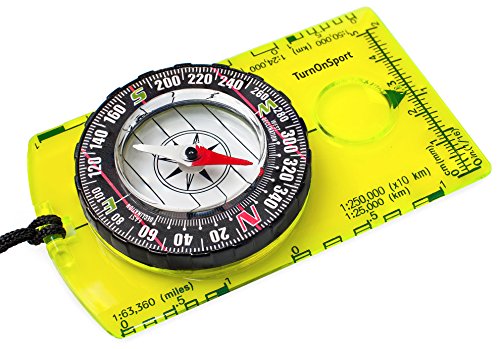
This manual magnet compass features an acrylic baseplate with an azimuth bearing and a 360-degree rotating bezel. A liquid-filled magnetic needle helps the needle swing quickly toward magnetic north, while the magnifying glass aids in reading geologic or topographic maps. The 1:24000 ruler scale supports precise route planning, and the compact, lightweight form makes it an essential piece of survival gear to keep in a pocket or hiking pack.
Designed for professional-style navigation, this model emphasizes accurate directions for hikers, campers, scouts, and outdoor educators. It balances portability with functional features that assist in quick bearings and map alignment, making it a versatile option for both novices and experienced navigators on day hikes or longer treks.
In use, the compass remains straightforward: orient the map, align the needle, and read bearings with the bezel. The product delivers dependable performance in various terrains, from woodland trails to open fields, where reliable orientation is critical for safety and efficiency.
SUUNTO A-30 NH USGS Compass

This compact baseplate compass pairs practical simplicity with a focus on northern hemisphere navigation. It features a high-grade steel needle with a jewel bearing and a fixed declination, providing dependable performance for hikers orienteering with a map. The luminescent markings support visibility in low-light conditions, while the transparent baseplate includes a magnifying lens for reading maps more easily.
Durability and reliability come from SUUNTO’s design heritage, with a balance of precision and portability for outdoor use. The A-30 NH model suits trail runners, hikers, and mountaineers who value a straightforward instrument that remains readable in varying light and weather. Its straightforward mechanics help ensure you stay on course during longer day trips or backcountry routes.
Sportneer Durable Orienteering Compass

Sportneer offers a high-precision compass designed for accurate bearings with a rear sight lens that magnifies the dial for easy readings. Maintaining accuracy requires keeping the compass level so the needle can rotate freely toward magnetic north. The construction emphasizes durability with a sturdy metal base and protective cover, ensuring reliability in rugged outdoor use and harsh weather conditions.
Versatility defines this compass. It suits camping, hiking, hunting, and scouting activities where dependable bearings matter. Its rugged navigation abilities help keep you oriented across diverse terrains, from forested trails to open ridges. The model’s waterproof and shock-resistant features extend its lifespan under active outdoor use.
Coghlan’s Carabiner Compass

Coghlan’s Carabiner Compass emphasizes portability and quick access. Its liquid-filled design provides smooth directional readings, while a built-in carabiner allows you to clip it to a backpack, belt, or gear for hands-free navigation. Luminous directional markers offer visibility in dusk or night conditions, enabling hikers to maintain orientation when light is limited or trail signage is scarce.
Compact and lightweight, this model is ideal for casual hikers, day-trippers, and kids beginning to learn navigation. The combination of a carabiner with a reliable compass makes it easy to carry without adding bulk, ensuring that your bearings are always within reach as you move through diverse terrain.
Buying Guide
Choosing the right compass depends on how you navigate and the environments you frequent. Consider these key purchase factors to align a compass with your hiking style and needs.
- Type and primary use: Lensatic (military-style) compasses emphasize rugged durability and precise bearings, while baseplate or orienteering models excel at map reading and long-distance navigation. Carabiner designs prioritize quick access and portability for light day hikes.
- Durability and weather resistance: Look for water resistance, robust materials, and shock tolerance if you hike in rain, snow, or dusty conditions.
- Readability features: Luminescent markings improve night visibility, magnifying lenses assist map reading, and a bubble level or declination adjustment helps with accurate bearings.
- Portability and weight: Lightweight, compact designs suit fast-paced trips; ensure the compass remains easy to access without weighing you down.
- Map-reading compatibility: Baseplates with clear scales and rulers support precise plotting and distance estimation on topographic maps.
- Maintenance: Choose models with simple cleaning and battery-free operation. Keep lenses clean and store in a protective pouch to extend life.
- Brand reliability and warranty: Reputable brands often provide better quality control and support, which matters on extended backcountry trips.
- Budget and value: Higher-priced units typically offer refined bearings, durable build, and long-term durability, but there are dependable affordable options for casual hikers.
- Usage scenario and terrain: For technical terrain, lensatic or advanced orienteering compasses may be preferred; for routine day hikes with map use, baseplate models often suffice.
Practical tips: practice using your chosen compass with a map before heading out, learn declination adjustment if needed, and regularly verify bearings by cross-referencing terrain features. A well-chosen compass pairs well with a reliable map and a compass-safe mindset for safe, confident navigation on the trail.