Enduro racing demands head protection that balances low weight, robust impact resistance, and all-day ventilation. The following five helmets are among the top-rated options for enduro and downhill riders, offering features such as MIPS protection, removable chin bars, and secure visors. Each model is built to perform on tough climbs and fast descents, while keeping comfort and airflow in mind. The quick-reference table below highlights the standout trait of each model to help you compare at a glance.
| Product | Brand | Notable Feature |
|---|---|---|
| POC Otocon Enduro Full-Face Helmet | POC | Lightweight, well-ventilated with removable cheek pads |
| Leatt Enduro 2.0 V23 Helmet | Leatt | Removable chin bar, sunglasses dock, Fidlock closure |
| Leatt Enduro 3.0 Helmet | Leatt | 3-in-1 design with chin bar and eye guards |
| POC Otocon Race MIPS Full-Face Helmet | POC | MIPS Integra, NFC Medical ID, RECCO |
| Demon Podium X MIPS Helmet | DEMON UNITED | 20+ vents, lightweight, MIPS |
POC Otocon Enduro Full-Face Helmet

Designed for downhill and enduro courses, this helmet emphasizes protection, ventilation, and everyday comfort. The outer shell is PC for durability, while the lower EPP section boosts impact resistance and sustainability. An EPS upper keeps weight low, supporting long rides and tight climbs. The liner’s injection-molded cage adds strength and stability, making it a reliable choice for aggressive terrain.
- Downhill-focused protection with endurance in mind
- Durable PC shell with impact-absorbing components
- Removable cheek pads and a grill for ventilation control
Leatt Enduro 2.0 V23 Helmet

This helmet emphasizes lightweight protection with a polymer shell available in multiple sizes. It features a removable chin bar for adaptability on different ride sections and a sunglasses dock for secure storage during climbs. The Fidlock magnetic closure system contributes to quick, reliable adjustments on rough terrain.
- Lightweight polymer shell in three sizes
- Removable chin bar with easy push-button system
- Sunglasses dock port and Fidlock magnetic closure
Leatt Enduro 3.0 Helmet
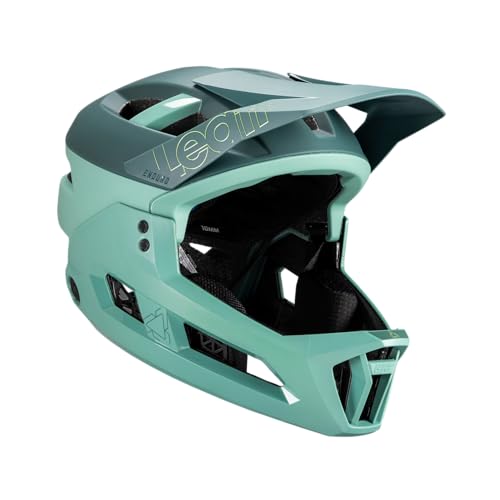
The Enduro 3.0 offers a versatile 3-in-1 design: a half-shell open-face mode, a removable chin bar, and optional over-the-ear guards with a secure push-button system. It includes PowerBridge in-molded protection to distribute impact forces and a sunglasses dock for convenient storage on fast descents.
- 3-in-1 versatility for different riding styles
- Removable chin bar and optional ear guards
- PowerBridge geometry and built-in sunglasses dock
POC Otocon Race MIPS Full-Face Helmet

Raising the protection level, this model combines a PC outer shell with a robust lower EPP section and an upper EPS layer to balance durability and weight. It features MIPS Integra for rotational impact protection, and a lower liner reinforced by an injection-molded cage. RECCO reflector and NFC Medical ID add value for riders tracking safety data on the trail.
- MIPS Integra rotational protection
- RECCO reflector and NFC Medical ID
- Durable PC shell with fortified lower liner
Demon Podium X MIPS Helmet

The Podium X MIPS focuses on advanced venting, comfort, and protection. It uses an integrated MIPS system to redirect rotational forces and features a highly engineered ventilation layout with 20+ vents for optimal airflow. With a lightweight construction that weighs roughly 710 grams, it aims to reduce neck fatigue without compromising durability. It carries downhill-grade certifications suited for enduro racing styles.
- MIPS safety technology for rotational impact
- 20+ vents for cooling and comfort
- Lightweight design around 710 grams
Buying Guide
Key purchase considerations help riders choose the right enduro full-face helmet for their needs. This guide summarizes practical factors without naming price ranges, focusing on protection, fit, and usability to support informed decisions.
- Protection technology: Look for MIPS or MIPS Integra systems that help redirect rotational forces. Consider helmets with reinforced lower liners and durable shells (PC or composite) for downhill and enduro environments.
- Ventilation and comfort: Enduro riding involves extended periods in varied climates. Prioritize helmets with multiple intake and exhaust vents, adjustable cheek pads, and grills or docks to fine-tune airflow during climbs and hot descents.
- Weight and comfort: Lighter helmets reduce neck strain over long sessions. Compare weight ranges provided by manufacturers and seek models with a balanced center of gravity and cushioned interiors.
- Modularity and adjustability: Removable chin bars, over-the-ear guards, and interchangeable visors enhance adaptability for different courses and weather conditions. Quick-release or magnetic closures improve on-the-fly adjustments.
- Fit and sizing: Ensure sizes reflect head circumference ranges and include adjustable fit systems. Proper fit is essential for protection and comfort during aggressive riding.
- Safety certifications and tech integrations: MIPS, RECCO reflectors, NFC Medical IDs, and other safety features contribute to on-trail safety and emergency responses.
- Durability and maintenance: Look for easy-to-clean liners and removable cheek pads. Check the robustness of the shell and the ease of replacing damaged parts after hard impacts.
- Brand reliability and warranty: Choose helmets from established brands with proven testing standards and customer support. A solid warranty can provide confidence after rough seasons.
Choosing the right enduro full-face helmet involves balancing protection, ventilation, and comfort for your riding style. By evaluating the five featured models against your course conditions and personal fit preferences, you can identify the helmet that best supports performance and safety on demanding enduro trails.