Choosing a pitching machine for baseball or softball practice requires clarity on wheel count, speed range, and pitch variety. This guide focuses on five options that align with the typical needs of youth players, coaches, and serious hobbyists seeking realistic three-wheel performance or compelling alternatives. The included table summarizes core specs at a glance, followed by detailed notes on each model’s strengths and typical use cases.
| Product | Brand | Type | Top Speed | Notes |
|---|---|---|---|---|
| Sports Attack Junior Hack Attack 3-Wheel Pitching Machine | Sports Attack | 3-Wheel Baseball | 70+ mph | Versatile for right/left throws |
| Jugs BP3 Softball Pitching Machine | Jugs | 3-Wheel Softball | 45-75 mph | 8 pitches; changeups with dial |
| Mound YETI-1 Baseball Pitching Machine | Mound Yeti | Single Wheel | 30-60 mph | Dual chutes; baseball/softball capable |
| Furlihong 747BH 4-Wheel Pitching Machine | Furlihong | 4-Wheel | 110 mph | Enclosed wheels; adjustable angles |
| BATA B2 Baseball Two Wheel Pitching Machine | BATA | 2-Wheel | 100 mph | Swivel head; versatile pitches |
Sports Attack Junior Hack Attack 3-Wheel Pitching Machine

The Junior Hack Attack 3-Wheel Pitching Machine is designed for youth leagues and advanced drills. It can throw right- and left-handed curves, sliders, split-fingers, knuckleballs, and fastballs up to 70 mph. The three-wheel arrangement enables rapid pitch changes, while the throwing head pivots to simulate ground balls, line drives, pop-ups, and fly balls up to about 250 feet. This model suits backyard practice, team clinics, and training sessions at high school, college, or professional levels, offering robust durability for repeated use.
Jugs BP3 Softball Pitching Machine

The Jugs BP3 Softball Pitching Machine delivers a state-of-the-art 3-wheel delivery with eight pitch options at the turn of a dial. It supports speeds from 45 to 75 mph and offers fastballs, changeups, right- and left-handed curves, screwballs, risers, and drops. A remote key-chain or onboard control panel button allows quick changes, while the Select-A-Pitch dial and micro-adjustment targeting provide precise control for softball batting drills. This model is well-suited for developing pitch recognition and swing timing in softball players.
Mound YETI-1 Baseball Pitching Machine
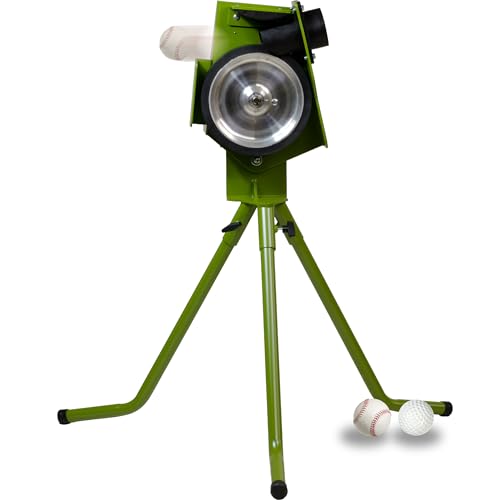
The Mound YETI-1 is a single-wheel pitching machine designed for mixed baseball and softball practice. It features two chutes to alternate between baseballs and softballs, with a speed range of 30–60 mph suitable for beginners to intermediate players. Reversible steel legs provide adjustable pitch height, enabling users to tailor height to batters, drills, and field setups. The unit is compact and portable, making it ideal for home yards and training facilities requiring flexible setup options.
Furlihong 747BH 4-Wheel Pitching Machine

The Furlihong 747BH uses four adjustable wheels to deliver a wide variety of pitches, with a max speed of 110 mph and a throwing distance of up to 450 feet. Wheels are enclosed for safety, and both horizontal and vertical angles are adjustable, enabling realistic fastballs, curves, and other pitch types. This model targets professional-level practice and coaching scenarios where high velocity and versatile pitch placement are priorities.
BATA B2 Baseball Two Wheel Pitching Machine

The BATA B2 Two-Wheel Pitching Machine offers automatic pitching with a three-way swiveling head to cover a wide pitching angle range. It reaches up to 100 mph and can throw various pitch types, including fastballs, curves, grounders, knuckleballs, sliders, and pop flies. Portable and easy to move, this model provides practical versatility for field drills, backyard sessions, and training plans requiring mobility and quick setup.
Buying Guide
- Wheel count and pitch diversity: Three-wheel units tend to offer realistic ball motion for batsmen, while four-wheel machines can support higher speeds and broader pitch repertoires. Two-wheel systems are typically simpler and more affordable but may offer fewer pitch options.
- Speed range and accuracy: Look for a machine with a speed range that matches your players’ level. Precise speed control and repeatable ball placement improve drill consistency and development.
- Pitch types: Consider whether you need fastballs, changeups, curves, screwballs, risers, knuckleballs, or sliders. Some models provide more built-in options or easier switching between pitches.
- Ball compatibility: If practicing both baseball and softball, prioritize machines designed for dual-ball use or that can accommodate different ball sizes and weights.
- Control options: Remote controls, smartphone apps, or onboard panels affect how easily you can adjust pitches during drills. Remote options often streamline practice flow.
- Safety and maintenance: Enclosed wheels, protective casings, and sturdy construction are important for safe, long-term use. Check for replacement parts such as wheels and components, and verify warranty terms.
- Portability and setup: If practice spaces vary, consider weight, footprint, and whether the machine disassembles for transport.
- Durability and warranty: Machines built for heavy use in clubs or schools typically come with stronger warranties and easier access to service parts.
- Pricing and intended use: Align cost with your primary use—home practice, team drills, or professional coaching—and factor in maintenance needs and part availability.
- Use-case alignment: For backyard or youth clinics, a 3-wheel or dual-purpose model often provides the best balance of realism and affordability; for high-velocity training, a 4-wheel option may be preferred.